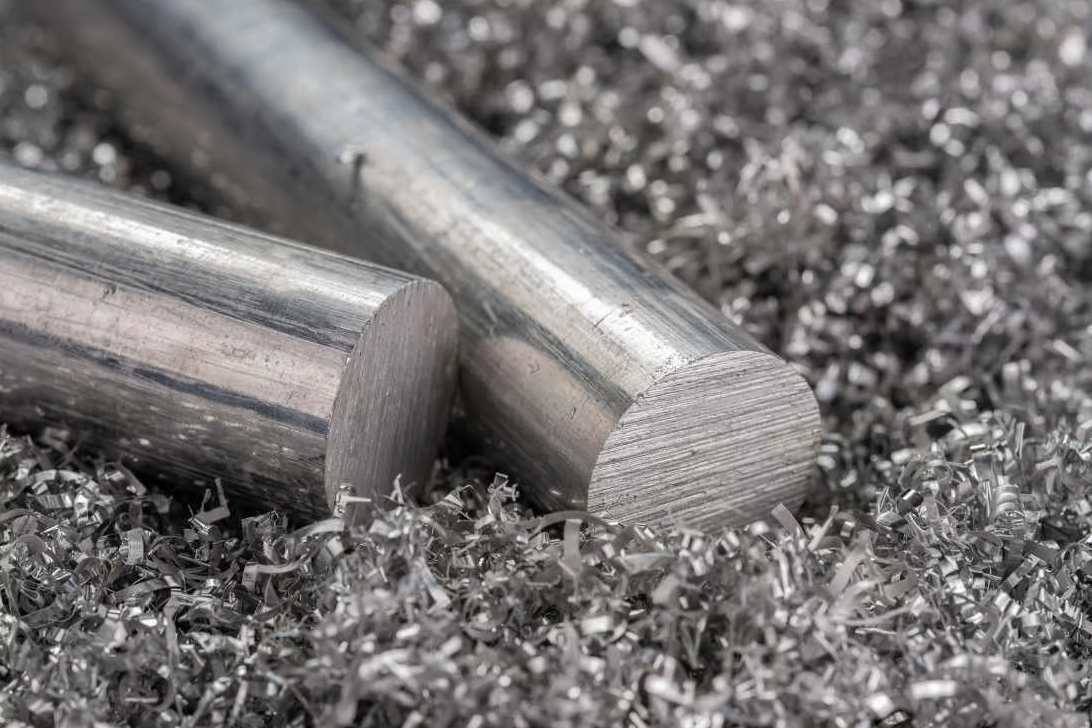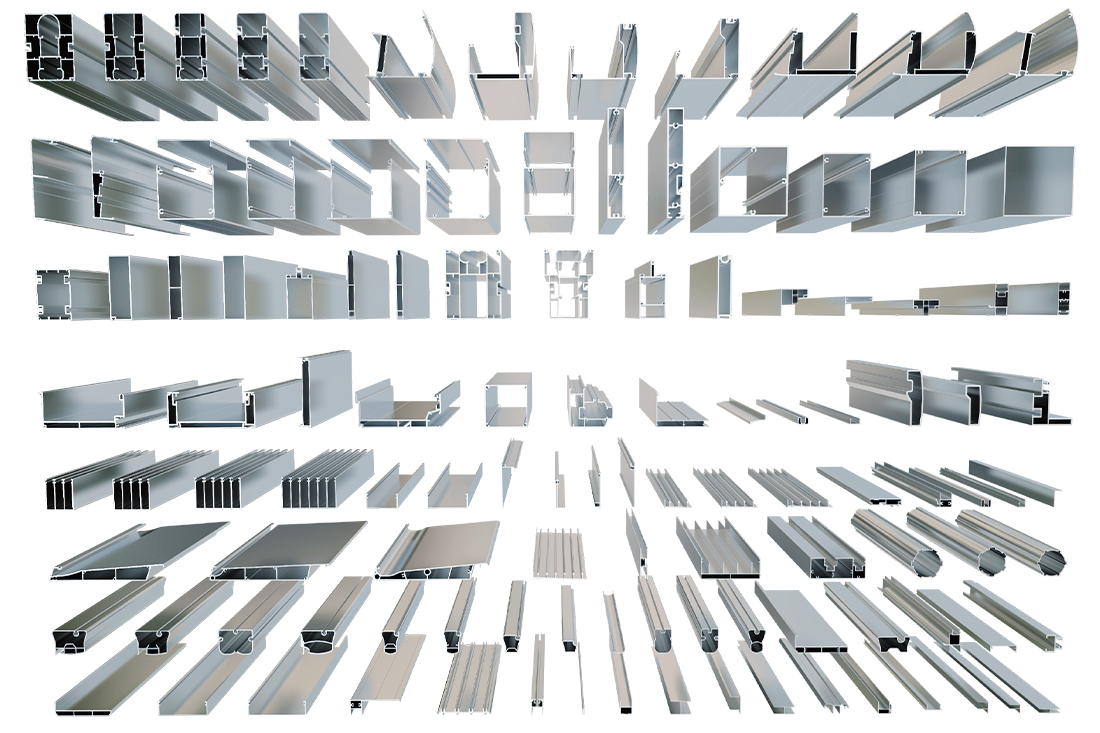


When an aluminum profile is ordered, the drawing, the dimensions and the colour are usually discussed at length. Yet the most fundamental decision, the one that determines how much load the profile can carry, how its surface will look after anodizing, how thin its walls can be and even what it costs, is often settled in a single line: the alloy. Technical specifications show short codes such as "6063 T5" or "6005A T6", but behind these codes are materials that behave quite differently from one another.
At Kenan Metal we cast our own billets in our own foundry and turn them into profiles on our own presses. In this article we explain, in plain language, the differences between the alloys most widely used in architectural and industrial profiles, namely 6060, 6063, 6005A and 6082, what temper designations actually mean, and which questions you should ask when choosing the right alloy for your project.
Why Are 6000 Series Alloys the Standard for Extruded Profiles?
Aluminum alloys are grouped into series according to their main alloying element. The 1000 series is almost pure aluminum; the 2000 series is based on copper, the 5000 series on magnesium and the 7000 series on zinc. The vast majority of extruded profiles, however, are made from 6000 series alloys, which contain magnesium and silicon. The reason is simple: together, magnesium and silicon form magnesium silicide (Mg2Si) precipitates, and these precipitates make the alloy heat treatable, meaning it can be hardened after extrusion.
This alloy family offers three important advantages. First, it flows easily through the die when hot, so complex, thin-walled and multi-cavity sections can be extruded at high speed. Second, after leaving the press its strength can be increased significantly through controlled quenching and artificial ageing. Third, it has good corrosion resistance and responds very well to surface treatment, so durable finishes can be achieved with anodizing and powder coating. In short, a 6000 series alloy strikes the best balance between ease of manufacture and in-service performance.
Within the series, though, the differences are large. As the magnesium and silicon content rises, strength increases, but extrusion speed drops and it becomes harder to maintain surface quality. Choosing the right alloy means setting this balance according to the needs of the project.
Alloy 6060: Surface Quality and Easy Forming
6060 is one of the "softest" and most easily extruded members of the 6000 series. Its silicon and magnesium contents are relatively low (both roughly in the 0.3-0.6% range). This lean alloy content allows the metal to flow very freely through the die. As a result, thin-walled, detailed sections with high aesthetic expectations can be extruded quickly and cleanly.
The greatest strength of alloy 6060 is its surface. Die lines are minimal, the colour tone after anodizing is uniform, and decorative applications benefit from a smooth, attractive finish. That is why it is widely used for window and door frames, interior profiles, decorative trims, furniture profiles, lighting housings and cladding panels, where appearance matters more than load. In T5 or T6 temper it offers tensile strengths roughly in the 150-190 MPa range, which is more than enough for many architectural applications.
Its weakness is load-bearing use. For a long-span pergola beam, a façade mullion exposed to high wind loads or a machine frame, 6060 alone often does not provide sufficient strength; in such cases either the section is enlarged or a stronger alloy is chosen.
Alloy 6063: The Versatile Choice for Architectural Profiles
6063 is the most widely used extrusion alloy in the world and is often called "the architectural alloy". Because its magnesium content can be kept in a slightly wider range than 6060 (roughly 0.45-0.9%), it delivers somewhat higher strength in the same temper. In T6 temper its tensile strength rises to around 200-215 MPa, with a yield strength of about 170 MPa.
Since 6063 combines good surface quality with reasonable strength, it is preferred across a wide range of products: aluminum joinery, sliding systems, guillotine glass profiles, winter garden profiles and most pergola and bioclimatic systems. It responds very well to anodizing and powder coating, and it is also suitable for thermally broken profiles with polyamide barriers. In our article on anodizing and painting techniques we explain in more detail why surface treatments give such good results on this alloy.
In practice you can think of it this way: if the main expectations of a project are appearance and low weight, but the profile still has to carry a certain load, 6063 is usually the most balanced starting point. Unless there is a specific reason, alloy selection for many architectural profiles begins with 6063.
Alloy 6005A: Strength for Load-Bearing Profiles
6005A is an alloy with a higher silicon content (roughly 0.5-0.9%) and small additions of manganese and chromium. This composition allows it to reach a tensile strength of around 260-270 MPa and a yield strength of about 215-225 MPa in T6 temper. In other words, 6005A is roughly one third stronger than 6063, yet it still allows sections of moderate complexity to be extruded.
Thanks to these properties, 6005A is used for load-bearing pergola beams, the main structural members of large-span bioclimatic systems, the rail profiles of moving roofs such as rolling roofs, scaffolding and platform components, solar mounting structures, and rail and automotive parts. The T-slot aluminum profiles that we often see in industrial machine frames are also usually specified in either 6063 or 6005A, depending on the loading conditions.
The price of 6005A is a somewhat lower extrusion speed and surface quality compared with 6063. Production becomes more demanding for very thin-walled, multi-cavity sections with high decorative expectations. For this reason 6005A is generally chosen for profiles where the structural function matters more than the visible surface.
When Does 6082 Come Into Play?
6082 is one of the highest-strength alloys in the 6000 series. It has high silicon, magnesium and manganese contents and can deliver a tensile strength of about 290-310 MPa in T6 temper. It is preferred for crane components, bridge and pedestrian walkway elements, heavy structural frameworks and machine parts operating under high loads.
However, 6082 is considerably harder to extrude. Press speed drops, die life shortens, complex hollow sections become difficult to produce and the surface quality is often not sufficient for decorative applications. That is why 6082 is usually selected for relatively simple sections and only where high strength is genuinely required. In an architectural project 6082 is rarely the first choice; it is usually more sensible, both in terms of cost and appearance, to look for a solution with 6063 or 6005A through smart section design first.
The Alloy Is Decided in the Casthouse
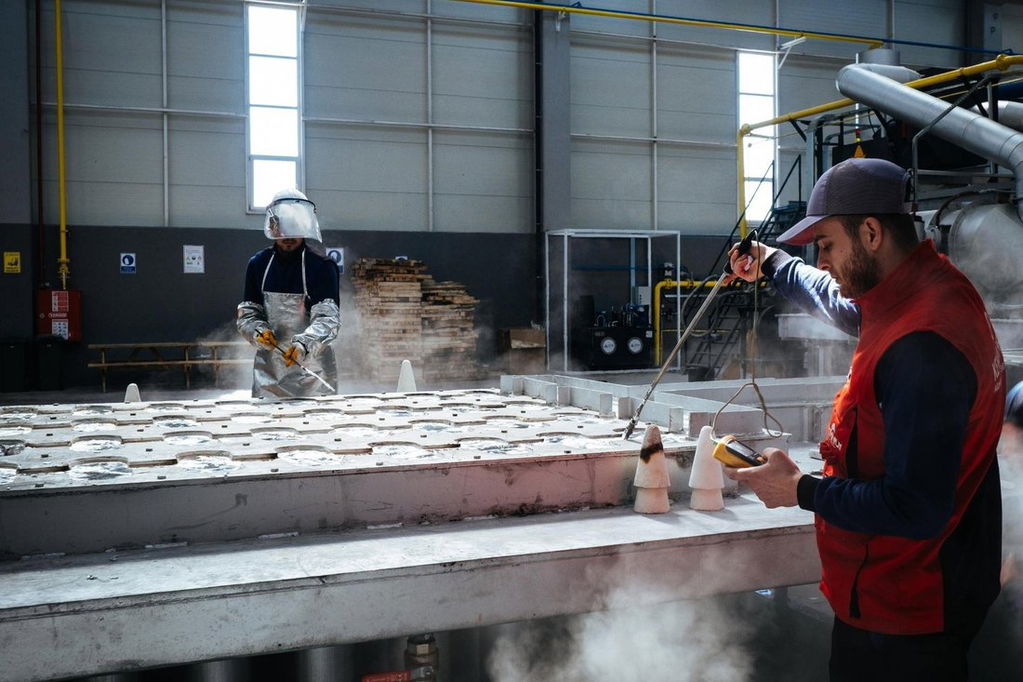
The alloy of a profile is not determined at the press but much earlier, during billet casting. Scrap and primary aluminum are melted in the furnace, and alloying elements such as magnesium and silicon are adjusted to the target range. Samples analysed with a spectrometer confirm that the chemical composition is within the limits of the standard. Once the composition is approved, the molten metal is filtered, degassed and cast into long cylindrical billets on vertical casting tables.
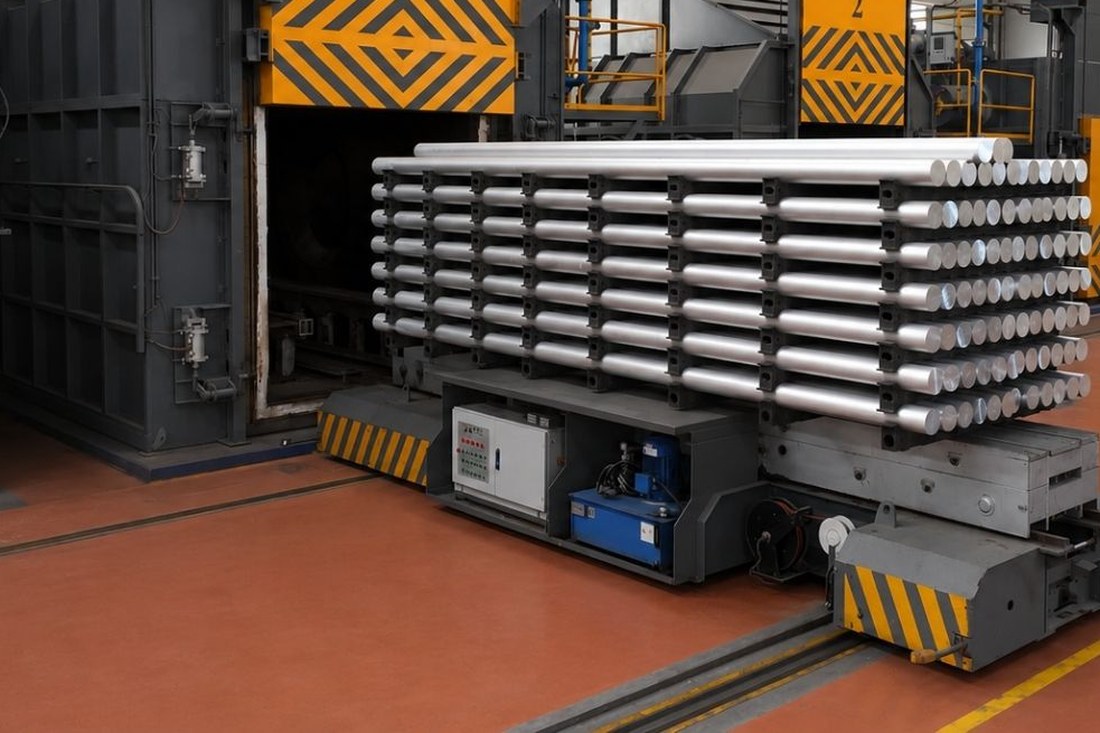
After casting, the billets are held in a homogenizing furnace for several hours. This process removes the internal stresses and unevenly distributed phases formed during casting, so the billet flows more evenly in the press, surface defects are reduced and the risk of colour variation after anodizing is lower. We discuss the effect of billet quality on profile quality in detail in our article on high-purity aluminum billets.
A manufacturer with its own billet production facility can fine-tune the alloy to suit the project. For example, within the lower and upper limits of the same 6063 standard, the composition can be kept close to the lower limit for an order where surface quality is the priority and close to the upper limit for an order where strength comes first. This flexibility is limited in a plant that works with purchased billets.
Temper Designations: What Do T4, T5, T6 and T66 Mean?
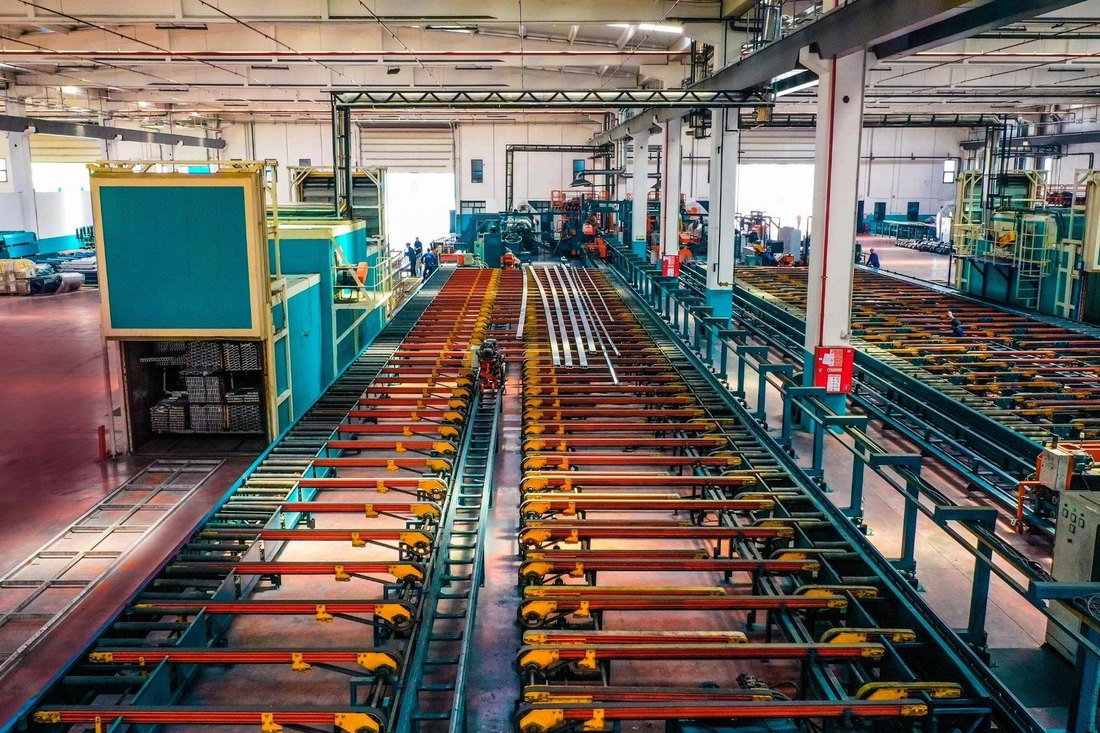
The alloy code describes the chemistry of the material; the temper code, made up of letters and numbers, shows which heat treatment has been applied to it. The same alloy can deliver very different strength values in different tempers. That is why writing only "6063" in a specification is an incomplete definition; the alloy should always be stated together with its temper, such as "6063 T5" or "6063 T6".
- T4: Solution heat treated and naturally aged. The profile is relatively soft; it is used as an intermediate condition for jobs that require bending and forming.
- T5: The profile is cooled in a controlled way as it leaves the press and then placed in an artificial ageing oven. Most architectural profiles are supplied in this temper; it offers a good balance between strength and cost.
- T6: Full solution heat treatment (or strong water quenching at the press exit) followed by artificial ageing. It achieves values close to the maximum strength available from the alloy and is preferred for load-bearing applications.
- T66: A special condition, mainly for 6060 and 6063, in which higher strength than T6 is targeted through tighter control of composition and process.
If the temperature and time in the ageing oven are not precisely controlled, the expected strength cannot be achieved from the same alloy. If you are curious about how heat treatment works inside the metal, our article on heat-treated aluminum approaches the subject from a scientific angle.
Section Design, Extrusion Speed and Surface Finish: Other Factors in Alloy Selection
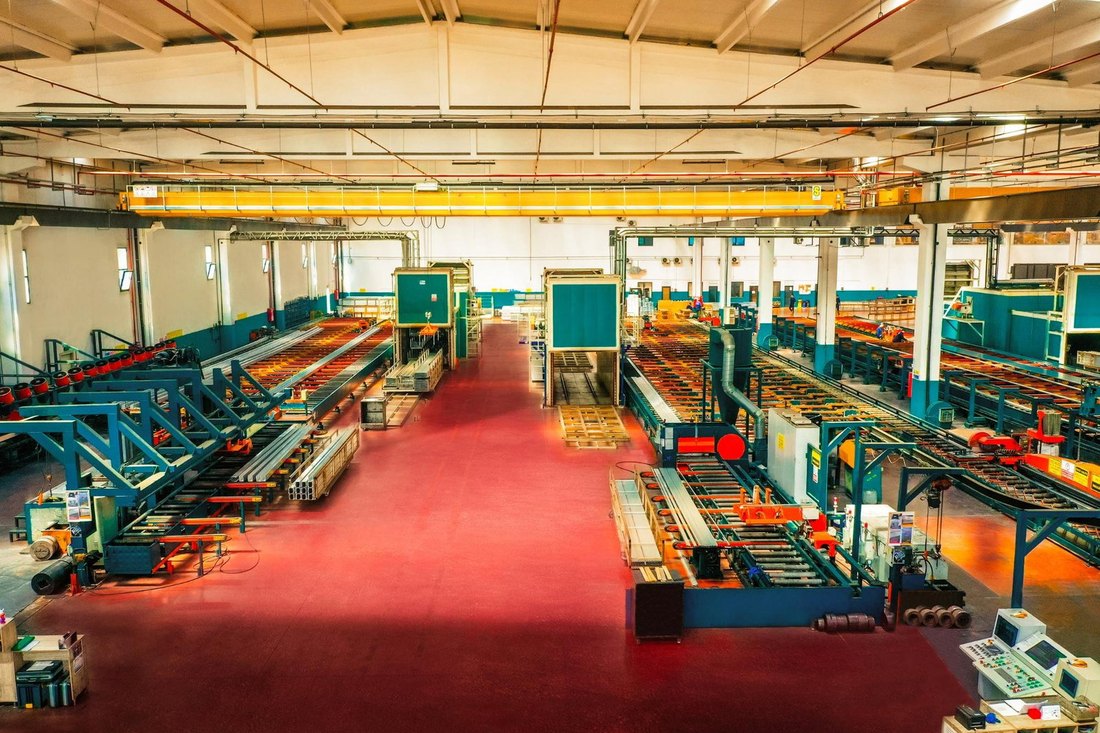
Choosing an alloy is not just a matter of "how much strength do I need". Section geometry, production efficiency and surface expectations are at least as decisive as strength. The following questions make a good checklist for arriving at the right alloy:
- How complex is the section? Multi-cavity, thin-walled or tight-tolerance sections are easier to extrude in 6060 and 6063. Extruding the same section in 6005A or 6082 makes die design harder and reduces production speed.
- Will the profile remain on a visible surface? For profiles that will be anodized, especially in natural or light anodized finishes, 6060 and 6063 give more uniform results. If the profile will be powder coated, the visual differences between alloys become smaller.
- What loads and spans are involved? The structural calculation reveals the required yield strength. Sometimes enlarging the section slightly or increasing the wall thickness is more economical than moving to a stronger alloy.
- Will the profile be machined afterwards? If drilling, milling, bending or welding is planned, the temper selection and the behaviour of the alloy should be assessed in advance.
- What are the environmental conditions? In aggressive environments such as the seaside, around swimming pools or in industrial atmospheres, the quality of the surface treatment is as important as the alloy itself.
These questions are also directly linked to die design. The same section may require different die approaches in different alloys; we cover this in our article on the aluminum extrusion die. You can learn more about the extrusion process itself on the page of our extrusion facility.
Quick Comparison: Which Alloy for Which Job?
The summary below is a starting point for alloy selection according to common applications. The final decision should always be made by assessing the structural calculation, the section design and the surface expectations together.
- Decorative profiles, interiors, furniture, lighting, cladding: 6060 (T5 / T6)
- Joinery, sliding and guillotine glass, winter gardens, standard pergolas: 6063 (T5 / T6)
- Large-span pergola and bioclimatic structural members, rolling roof rails, solar structures, industrial frames: 6005A (T6)
- Heavily loaded machine and structural elements, simple high-strength sections: 6082 (T6)
These boundaries are not rigid. For example, a pergola installed in a high-wind region may require 6005A instead of 6063; conversely, in a small system 6005A can create unnecessary cost and production difficulty.
Frequently Asked Questions
Is there a visible difference between 6063 and 6060?
In a mill-finish profile the difference is usually not visible to the eye. It becomes apparent on the surface after anodizing and in strength tests. 6060 can give a slightly brighter and more uniform surface, while 6063 offers slightly higher strength in the same temper.
Is a stronger alloy always better?
No. A high-strength alloy in a project that does not need it only slows down production, increases die cost and may reduce surface quality. The right alloy is the one that meets the requirement at the lowest total cost.
How can the alloy of a profile be verified?
A reliable manufacturer should be able to provide, for every batch, a quality certificate showing the cast number, the chemical analysis results and the mechanical test values. This document records the alloy and temper in which the profile was produced. We have gathered the other points you should ask about when evaluating a supplier in our article on what to look for when choosing an aluminum extrusion manufacturer.
Can I request a special alloy?
Project-specific adjustments can be made within the composition ranges allowed by the standard alloys. Manufacturers with their own casthouse are more flexible in this respect; however, a request for a non-standard alloy is assessed separately in terms of minimum order quantity and lead time.
Conclusion
Alloy selection is the first and most fundamental decision that determines the performance, appearance and cost of an aluminum profile. 6060 stands out for its surface quality and ease of forming, 6063 for its balanced character, 6005A for its structural strength and 6082 for its high load capacity. When the right alloy is considered together with section design, temper and surface treatment, the result is a product that is both economical and long-lasting.
Kenan Metal determines the alloy in its own casthouse and manages die making, extrusion, heat treatment and surface finishing under one roof, keeping all of these decisions within a single quality chain. If you are not sure which alloy is right for your project, you can contact our technical team together with your section drawing.